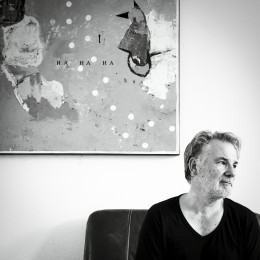
I began painting out of urgency and necessity — then expanded into a broader quest to grasp reality, beginning with my own memory and reaching toward a collective dimension. Self-taught, yet immersed in a rich cultural lineage — from Caravaggio to Joy Division, Manet to Coppola, with detours through Bacon, J.P. Witkin, Twombly — I borrow from the spirit of the times: childhood memories (photos, objects, words), news fragments, famous figures, song lyrics. These reappear recurrently in my work — not as illustration, but as raw material transformed into form, generating further forms.
On large formats, images emerge intuitively, almost automatically. I aim to “let the hand move faster than the brain.” Motifs collide percussively — often a shape and a word, a figure and a phrase — and ambiguity reigns. Forms are deliberately imprecise, imperfect; juxtapositions are left open, mirroring my perception of the world: fluid, chaotic, impenetrable.
Line, trace, and drawing hold central importance. Acrylics, inks, and pencils are applied without demonstrative intent. Chromatic relationships are carefully considered: a subtly worked background against which black, red, or white “rub against” or “dissolve into” through direct contrast.
Each painting presents a flat, planar surface — depth is avoided, yet space is present. I explore the limits of deformation, hovering at the edge of unreality. The pictorial and poetic balance, the force that inhabits or emanates from each work, is central. Interwoven lines, barely sketched organic, vegetal, or human forms on the paper’s surface allow me to continually question the uncertainty of being, the world, representation — and the emergence of “presences” revealed through paint.
Philippe Croq


 –
–
 –
–